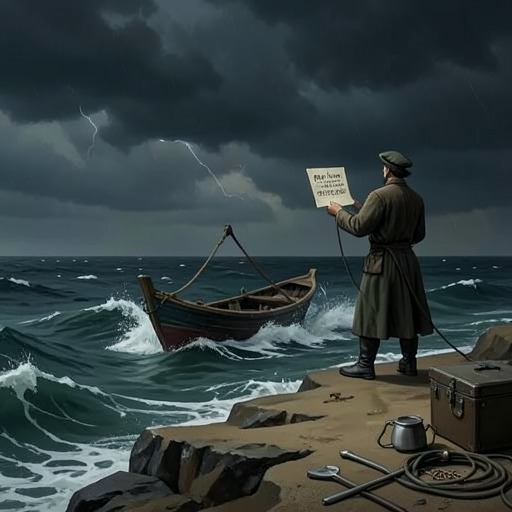
Portland Bay
The Man Who LaughsPortland Bay is both a treacherous maritime landscape and a place of temporary concealment in the winter episode surrounding the Matutina. Its narrow creeks offer refuge precisely because they are dangerous to approach, but that shelter is precarious: a vessel can hide beneath the cliffs only briefly before it must enter the open sea. The bay’s darkening landscape turns a departure into a passage from concealment toward pursuit, storm, and uncertainty.
Geography and Maritime Character
The bay is lined with small inlets whose safety depends on the weather and the skill of those navigating them. Many have sand-bars; in heavy weather the sea becomes rough, and passing through safely requires practice. These ports are ports largely in appearance: hazardous to enter and frightening to leave. Their limited usefulness is part of what makes them suitable hiding places for vessels seeking concealment.
One creek is singled out as the most dangerous in the bay under certain winds, and therefore the loneliest. A Biscayan hooker lies close beneath a cliff, in deep water, moored to a point of rock. The setting is vertically enclosed: precipices rise higher than the creek is wide, and the only place to land is a low, level projection reached by a plank from the vessel. The path above is steep and sharply zigzagged, more a descent than a road. The geography allows communication between ship and shore, but makes every crossing exposed and difficult.
On the evening of the scene, the usual maritime danger briefly abates. The water is calm, and a northern screen of rock shelters the creek from the sea, making it less cold there than offshore. Yet the people boarding still shiver and hurry. The sheltered inlet offers no comfort that can overcome the urgency of their movement; it is a narrow interval of relative safety, not a secure refuge.
Concealment and Departure
As evening advances, the creek’s enclosure becomes a visual mechanism of concealment. Twilight thickens into gloom at the bottom of the cliffs, while the narrow opening to the sea remains a pale break against the dark interior. The hooker is difficult to make out beneath the cliffs’ shadows. A plank connects it to the landing point, and dark figures cross back and forth as some people embark. Their ragged clothing is visible in the fading light, marking the group as poor and vulnerable without identifying each person individually.
The scene then widens from the hidden creek to the bay seen from above. Snow and sea-foam make land and water alike white, while the sea is sharply defined against the black cliff. From the child’s height, the bay appears as a pale semicircle enclosed by dark hills. No lit window, hearth, inhabited house, or lamp marks the coast; the absence of human light makes the departing vessel conspicuous even as distance diminishes it.
The hooker moves away as a black triangle across the water. Once it lights its prow lantern, the small point of brightness seems to cling to its long dark shape. The vessel grows smaller and fades toward the horizon. The contrast between the lantern and the unlit shore makes the ship’s departure at once visible and isolating: it carries a single light into a landscape where no other sign of habitation can be seen.
The Bay as a Threshold of Risk
The Matutina’s passage turns the bay from shelter into a threshold. As the wind begins to rise and the fog rolls back, other vessels appear, hurrying toward anchorage from different parts of the coast. Their movement establishes the coming storm as a general maritime danger: ships are racing for refuge, while the Matutina has already put out to sea. The lull overhead and the gathering darkness sharpen the contrast between the vessels seeking safety and the hooker continuing away from land.
After rounding the cape, the Matutina enters the open sea. A nor’wester catches it broadside; the vessel staggers, then recovers and keeps its course. The narration reads this course as evidence of flight rather than ordinary travel, suggesting that the fugitives fear pursuit on land even more than the sea. Portland Bay therefore marks a decisive boundary in the episode: the creek can conceal the ship and permit embarkation, but it cannot protect the people once they leave its shelter.
A Coast Altered by Human Use
The bay’s landscape also carries a longer history of change. Portland’s coasts, once described as cliffs shaped by the sea, were increasingly cut by quarrying after quarrymen and plasterers began working the area in the middle of the seventeenth century. Portland stone became useful for making Roman cement, enriching the district while altering its appearance. The narrative contrasts the ocean’s grand, irregular erosion with the measured strokes of human extraction.
That transformation reaches the very kind of place where the Matutina had been moored: the creek is described as having been worked away, so that the little anchorage no longer remains. The narrative’s account of the present-day altered coast overlays the earlier scene of a concealed ship and a barely visible landing. Portland Bay is thus more than a dramatic backdrop. Its hazardous inlets govern the fugitives’ movement, its darkness and distance shape how their departure is seen, and its changing shoreline records the loss of the natural refuge that once made the episode possible.